
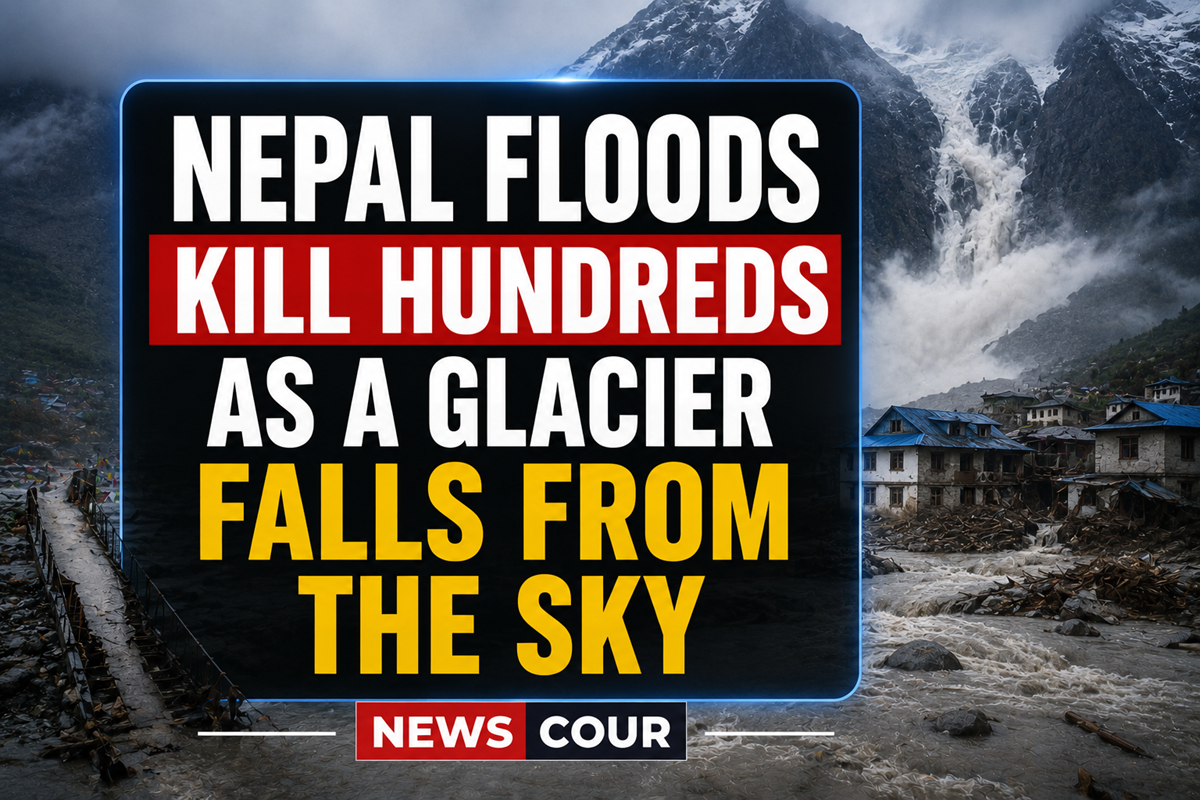
A wall of water nearly 30 feet high came down a Himalayan river valley with almost no warning. Within minutes, whole communities along the Nepal-Tibet border were gone.
The Nepal floods of 26 August have become one of the deadliest disasters the region has seen in years, with more than 675 confirmed dead in the country, several more across the border in Tibet, and thousands still missing. Many of the missing are foreign pilgrims and trekkers, including around 90 Americans, drawn to the sacred routes toward Mount Kailash in Tibet.
Here is what triggered the disaster, why the toll climbed so fast, and what it reveals about a rapidly warming Himalaya.
What Caused the Nepal Floods
The trigger was not rain. The weather was clear when, at about 8:37 a.m. local time, an enormous slab of glacier roughly 2,000 feet wide sheared off Langtang Lirung mountain.
The collapse sent ice, rock, and boulders the size of cars crashing thousands of feet down into a tributary of the Bhote Koshi River. The impact was so violent that seismometers registered it as a magnitude 5.2 tremor, and authorities briefly mistook it for an earthquake.
Scientists are still working out the exact mechanics, including whether debris temporarily dammed the river before releasing a second surge. What is clear is that river levels rose by as much as nine meters in half an hour, producing what one researcher described as liquid concrete tearing through narrow gorges.
A Rising Toll Across the Border
The human cost has climbed steadily since Wednesday. In Nepal itself, more than 675 people are confirmed dead and over 2,400 remain missing, while across the border Tibet has reported additional deaths and hundreds more unaccounted for.
The disaster obliterated the Gyirong Port complex, the main trade and tourism gateway between Nepal and China. The torrent was so powerful that it carried some victims’ bodies as far as 240 kilometers into neighboring India.
Rescue has been brutally hard. Wrecked roads, downed power lines, bad weather, and mountainous terrain have all slowed teams, even as thousands of police and army personnel deployed and helicopters lifted stranded survivors from rooftops.
Why the Nepal Floods Point to a Warming Himalaya
Scientists are cautious about tying any single event directly to climate change, but the backdrop is hard to ignore. The Hindu Kush Himalaya region is warming faster than much of the planet, and its people live directly downstream of the ice.
According to research from the International Centre for Integrated Mountain Development, the rate of ice loss from the region’s glaciers has doubled since 2000. As glaciers shrink and permafrost thaws, the frozen material that holds steep mountainsides together gives way more easily.
The World Meteorological Organization has long warned that mountain hazards like these are intensifying as the climate warms. This was not the region’s first such catastrophe, either, with glacial lake outburst floods striking these valleys in both 2024 and 2025.
The Threat That Has Not Passed
Even now, the danger is not over. Chinese authorities warned that a lake formed from flood debris had begun to overflow, and rescue work in some border areas was halted as a precaution.
That is the cruel arithmetic of these mountains. A disaster can arrive in minutes, and the conditions that produced it can linger for days, forcing rescuers to weigh saving the missing against exposing themselves to the next surge.
International teams have now assembled to study the collapse, hoping better monitoring can give downstream communities the warning they did not get this time. Experts stress that some unstable glaciers do show measurable signs before they finally fail.
What Happens Now
The immediate priority remains search and recovery, alongside aid for the tens of thousands displaced across the affected districts. Nepal has issued fresh flood warnings for communities along several rivers as the region stays on edge. Aid agencies are racing to reach cut-off villages before more rain arrives, and officials say the final death toll will not be known until the debris fields are fully searched.
For the families still waiting, the wait is its own agony, scanning helicopter manifests and hospital wards for names. The Himalaya has always been beautiful and dangerous in equal measure, and this week it reminded the world, in the harshest way possible, that the old balance is shifting.
For background on how a warming climate is reshaping water systems, see our explainer on how a desalination plant works.
The mountains gave no warning this time, and the race now is to make sure the next collapse does not catch these valleys the same way.