
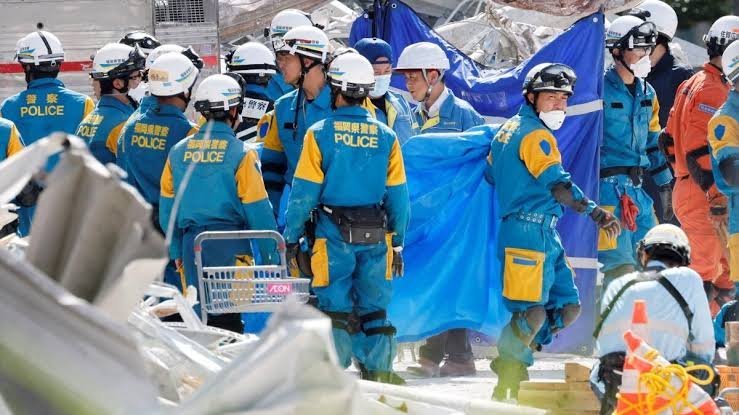
A shopping mall that reopened just six weeks ago as a symbol of recovery from Japan’s last major earthquake became one of the deadliest sites of its next one.
This Japan earthquake, a magnitude 7.1 tremor that struck Kumamoto Prefecture on Kyushu island Tuesday afternoon, has killed at least 35 people as of Friday, with rescuers racing against a critical 72 hour survival window that has now closed. An explosion tore through the Aeon Mall shopping center in the town of Kashima roughly 80 minutes after the quake, killing at least seven people, while eight more died when a chimney collapsed at a Nippon Paper Industries mill in the city of Yatsushiro.
Here is what happened, how the death toll climbed so quickly, and what the region is bracing for next.
How the Japan Earthquake Unfolded
The Japan earthquake struck the Uki and Hikawa areas of Kumamoto Prefecture at 4:27 p.m. local time Tuesday, with the Japan Meteorological Agency recording a magnitude of 7.1 at a depth of about 10 kilometers, though the US Geological Survey later revised its own estimate to 6.8. A tsunami advisory was issued immediately and later lifted. Six aftershocks followed within hours, and the agency has since warned that strong aftershocks remain possible for at least a week, with the highest risk concentrated in the first two to three days.
The mall explosion produced the single deadliest scene of the disaster. Aeon Mall Kumamoto, which hosts roughly 200 stores and had reopened only in mid June after being rebuilt following the devastating 2016 Kumamoto earthquake, saw part of its second floor collapse after what officials believe was a gas explosion triggered by the shaking. The reopening had been meant as a symbol of recovery, complete with a supermarket that once offered discounted rice balls to survivors of the earlier disaster.
The Toll of This Japan Earthquake, Day by Day
The confirmed death toll climbed sharply through the week as search teams reached more sites. Prime Minister Sanae Takaichi announced 13 dead on Wednesday morning, telling reporters that every second counted for those still waiting to be rescued. The count rose to 25 by Thursday, then 30 later the same day, and reached 34, then 35, by Friday as the Kumamoto prefectural government confirmed additional deaths tied to the disaster, including some still under investigation for a direct link to the quake. Six people pulled from the rubble remain in serious condition, and dozens more have been injured.
Damage to infrastructure has compounded the crisis. More than 80,000 households remained without water and roughly 4,500 without electricity as of Friday, according to the Japan Meteorological Agency, which has continued to issue aftershock guidance throughout the week. More than 9,000 people are staying in evacuation shelters, where authorities have been adding power sources for air conditioning as temperatures climbed toward 97 degrees Fahrenheit, raising fears of heat-related illness among displaced residents already coping with disaster.
A Region That Has Been Here Before
Kumamoto’s history with earthquakes makes this Japan earthquake’s toll especially painful. A magnitude 7 quake that struck the same prefecture in April 2016 ultimately killed 277 people in a disaster that reshaped building codes and disaster planning across the region. That earlier catastrophe is the reason Aeon Mall existed in its rebuilt form at all, and the reason so many residents interviewed this week described a grim familiarity with sleeping in their cars or evacuation centers. One Hikawa resident in her 70s told reporters she had done exactly this before, in 2016, and still found the fear of each fresh tremor impossible to shake.
In the town of Hikawa, one of the hardest hit areas, officials said more than 800 of the town’s 4,500 homes were destroyed or damaged, forcing many residents into their vehicles or public parking lots rather than shelters.
What Happens Now
With the 72-hour window widely considered most critical for finding survivors now closed, search operations are shifting toward recovery even as crews continue working sites including the collapsed mall and the damaged paper mill. Officials have not yet said how many people remain unaccounted for, and the full scale of housing damage across the prefecture is still being assessed. For a region that rebuilt once already, the immediate question is how much of this week’s damage represents a second such undertaking, a challenge playing out in different form wherever emergency crews are stretched thin this summer, including the Oregon wildfires burning on the other side of the Pacific.
Follow NEWSCOUR for more updates!