
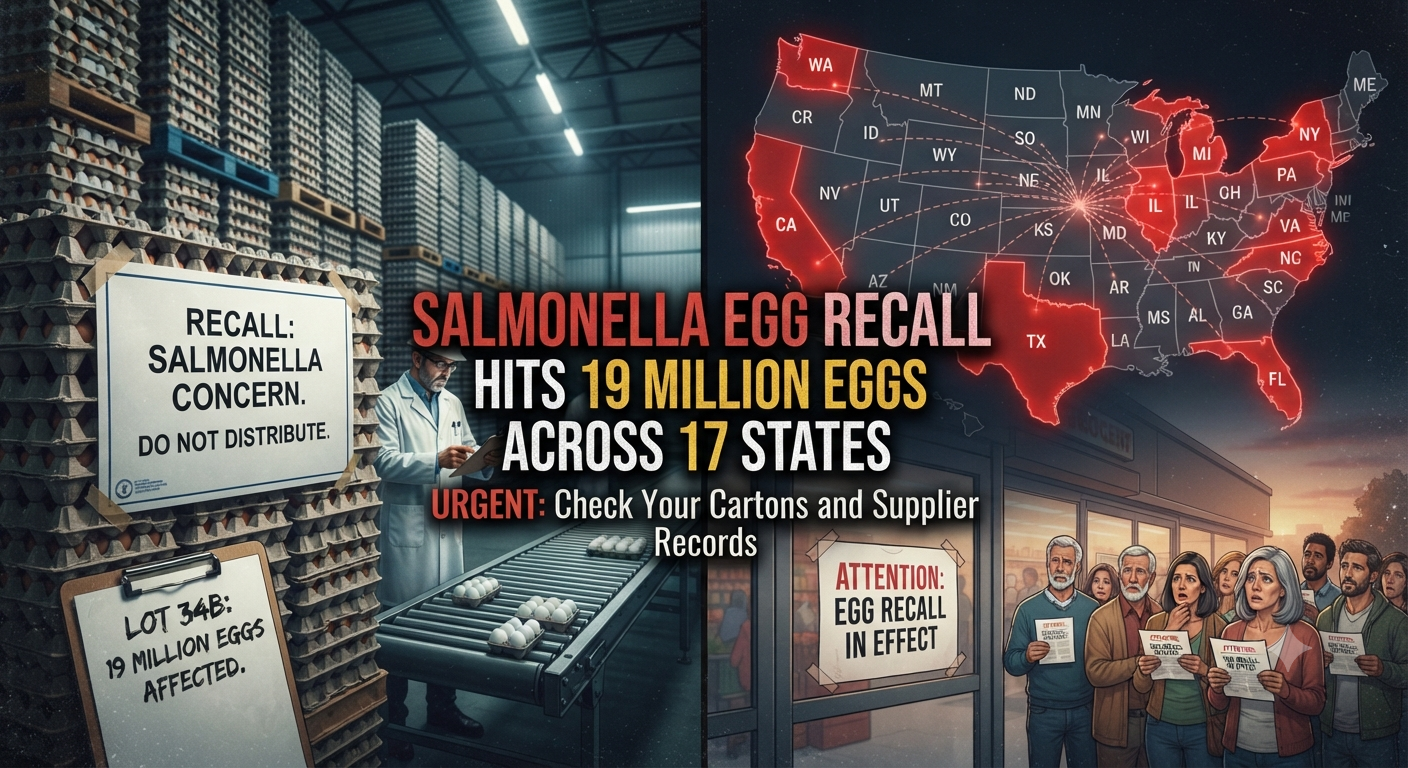
Nearly 20 million eggs are now off the shelves after federal investigators traced a growing Salmonella outbreak back to a single Texas producer.
This Salmonella egg recall covers 1,589,577 dozen eggs, more than 19 million individual eggs, produced and distributed by Midwest Poultry Services from farms in Texas. The Food and Drug Administration says the recalled eggs are the likely source of an outbreak that has sickened 98 people across 17 states, hospitalizing 26 of them, though no deaths have been reported. The affected cartons were sold under the Kroger, Simple Truth, and Brookshire’s brand names.
Here is which eggs are covered, how the outbreak was traced, and what to do if you have any in your refrigerator.
What the Salmonella Egg Recall Actually Covers
The recall spans medium, large, extra large, and jumbo brown and white shell cage-free eggs, all produced and distributed between June 6 and July 3, 2026. Not every carton with a matching brand name is affected. The FDA says consumers need to check the specific best-by dates and plant codes listed in the recall notice against the cartons in their refrigerator, since eggs that do not match every detail exactly are not considered part of the recall and remain safe to use.
Illnesses in the outbreak began as early as November 21, 2025, with the most recent reported case falling ill on June 30, 2026, according to the Food and Drug Administration. The bulk of the cases, 73 of the 98 confirmed, were concentrated in Texas, with four more in Arizona and five in Louisiana, suggesting the outbreak has so far stayed heavily regional even as the recall itself reaches a national footprint through major grocery chains.
How Health Officials Traced the Salmonella Egg Recall
The FDA said laboratory, epidemiological and traceback data together pointed to the Midwest Poultry Services eggs as a likely source of the outbreak, the standard combination investigators use to link illnesses in different states back to a single supplier. The agency has said it is continuing to investigate whether other sources may also be contributing to the broader Salmonella case count, meaning the picture could still expand beyond the current recall.
The strain behind this Salmonella egg recall typically causes diarrhea, fever and stomach cramps beginning 12 to 72 hours after exposure, and most healthy adults recover within four to seven days without treatment. The illness can be more severe in young children, older adults and people with weakened immune systems, for whom it can sometimes spread beyond the intestines and require hospitalization, which is reflected in the 26 hospitalizations already recorded in this outbreak.
What to Do If You Have These Eggs
Responding correctly to the Salmonella egg recall starts with checking whether your eggs match the recalled brand names; you should check the full carton details against the FDA’s published recall notice rather than relying on brand name alone. If your eggs match, do not eat them; either discard them or return them to the store where they were purchased. Because Salmonella can survive on surfaces the eggs contacted, the FDA recommends washing any containers, shelves or utensils the recalled eggs may have touched with hot, soapy water. Anyone experiencing Salmonella symptoms after eating eggs is advised to contact a healthcare provider, particularly if symptoms are severe or persistent.
What Happens Now
The FDA has not indicated when the investigation will formally close, and the agency’s willingness to expand its search for additional sources suggests the case count could still grow before it shrinks. For now, the safest approach for anyone who bought eggs under the affected brands in the past two months is to check the recall notice directly rather than assume a carton is safe, the same close-reading approach worth applying whenever a foodborne illness outbreak is traced back to a specific product.
Follow NEWSCOUR for more updates!