
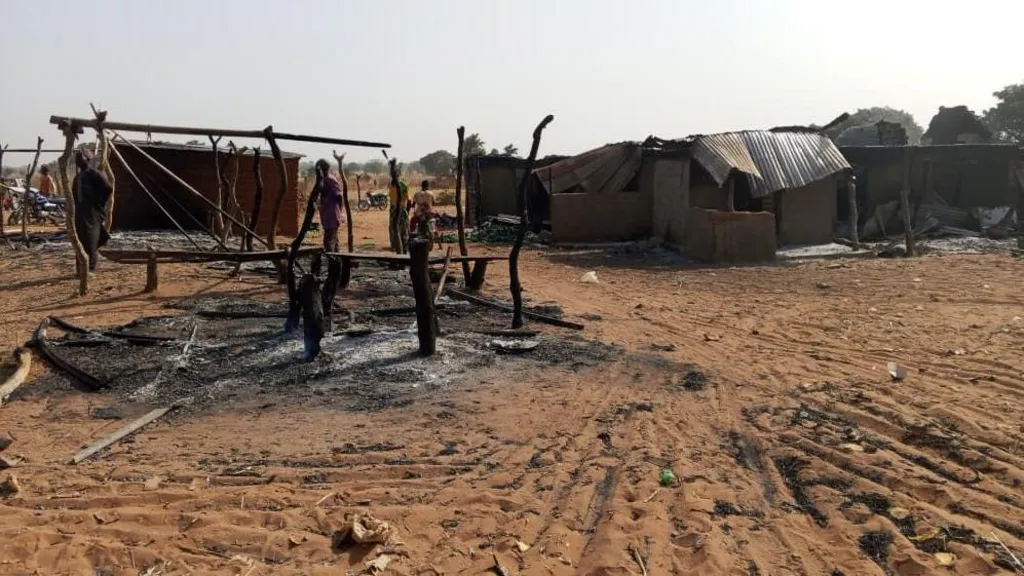
The gunmen who attacked Naridon village late Sunday night had been there before. Almost exactly a year earlier, they, or others like them, hit the same community and left.
This Nigeria village attack killed at least 30 people, including as many as eight children, when armed men stormed Naridon in Kaduna State’s Kaura council area shortly after midnight, opening fire, burning homes and shops, and leaving several more residents wounded. No group has claimed responsibility, and by Monday morning bodies had been moved to a nearby hospital as families began arranging burials.
Here is what happened, why this specific community was targeted again, and what it says about a security crisis that has outlasted every attempt to contain it.
How the Nigeria Village Attack Unfolded
Residents said the gunmen arrived late Sunday and moved through Naridon largely unopposed, according to Yunusa Babados, a local official who described attackers opening fire indiscriminately as they burned homes and shops. Derek Christopher, chairman of the Southern Kaduna Peace and Security Network, said security personnel did not reach the village until hours after the attack had already ended. One resident, Raphael Joshua, told the Associated Press he had spent the morning helping move the bodies of the dead to a hospital while relatives prepared for funerals.
Christopher’s statement carried a harder edge than most: the same community, he said, was attacked around this same time last year, a detail he offered as evidence that the government has effectively abandoned any intention of protecting the area. I don’t know who these people have left to fight for them, he said.
Why Nigeria’s Bandit Violence Keeps Returning to the Same Villages
This Nigeria village attack fits a pattern that has become grimly familiar across the country’s northwest and north-central regions. Armed groups known locally as bandits, many of them former herders who took up arms after disputes with farming communities over land and water, carry out raids, kidnappings for ransom, and cattle rustling with little fear of consequence. That violence is distinct from, though sometimes overlapping with, the Boko Haram and Islamic State West Africa Province insurgency concentrated in the northeast.
Analysts point to the same structural weaknesses behind nearly every attack: underfunded local policing, poor intelligence sharing between security agencies, and a rural geography that lets armed groups strike and disappear before help arrives. Nigeria’s National Emergency Management Agency coordinates the country’s disaster response, but the deeper security response falls to police and military units stretched thin across multiple active conflict zones at once.
The Wider Pressure on Nigeria’s Security Forces
The Nigeria village attack lands amid a broader diplomatic strain, as the United States has criticized Nigeria’s government over its record protecting Christian communities, tension serious enough that Washington carried out airstrikes in December against camps linked to Islamist militants operating in the country. Separately, US and Nigerian forces conducted a joint operation this year that killed a senior Islamic State group leader. None of that federal-level activity reaches communities like Naridon, where the threat comes from armed groups with no ideological banner beyond profit and territory.
The strain on protection resources is not unique to Nigeria this year. Emergency and security services on multiple continents have been tested by overlapping crises this summer, from public health emergencies in Central Africa to the DRC Ebola outbreak straining an already fragile response system in a neighboring region.
What Happens Now
No arrests have been announced, and no group has claimed the Nigeria village attack, consistent with most bandit raids in the region, where anonymity is part of the tactic. For residents who lived through an almost identical attack last year, the immediate question is not accountability but whether anyone will still be living in Naridon by the time gunmen return again.
Follow NEWSCOUR for more updates!