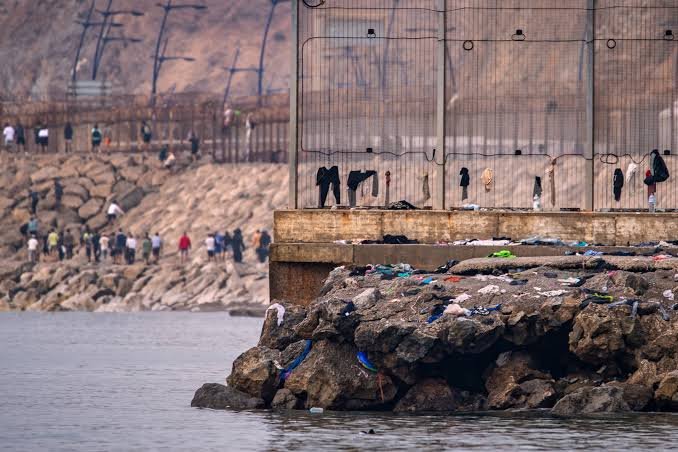
A city of 84,000 people absorbed a crowd more than half its own size in a single day, and dozens did not survive the attempt.
The Ceuta border crisis has killed at least 67 people, Spain’s government confirmed Saturday, after 50,000 to 60,000 migrants breached the frontier separating Morocco from Ceuta, Spain’s tiny North African territory, on Thursday. The dead include people who drowned attempting a sea crossing and others killed in a stampede at a breakwater barrier.
Most of those who entered have since returned to Morocco, but the political aftershocks are still spreading across Europe, from new border checks in Italy to sharp words between Madrid and Brussels.
Here is how the crossing happened, why the death toll is still disputed, and what it has already changed in European border policy.
How the Ceuta Border Crisis Unfolded
This chapter of the Ceuta border crisis broke open Thursday when tens of thousands of people, mostly Moroccan, walked and swam around breakwaters into Ceuta, overwhelming Guardia Civil border guards who normally handle a fraction of that volume. Video from the scene showed crowds streaming over local roads, some cheering and kissing the ground upon reaching Spanish territory.
Spain’s Interior Ministry ordered Army units already stationed in Ceuta to provide logistical and surveillance support, while the Guardia Civil retained direct policing contact with those crossing. By Friday, roughly half of those who entered had already returned to Morocco, and by Saturday morning residents described an uneasy calm returning to streets that had been packed for days.
Not everyone left willingly. A handful of exhausted migrants who swam to Ceuta’s Tarajal beach Saturday morning were met by soldiers and escorted back across the border. Among those who stayed was Mohamed Hatri, a 23-year-old Moroccan, who told reporters authorities had cut off food supplies specifically to force people like him to leave, and that he intended to remain regardless.
Why the Ceuta Border Crisis Death Toll Keeps Shifting
Casualty figures in the Ceuta border crisis were inconsistent for days before settling near their current level. Reuters initially reported at least 57 deaths, the Associated Press put the figure at 41, and police sources cited by El Pais separately reported 43 bodies recovered, discrepancies that reflected both the timing of each update and the difficulty of confirming whether every body found nearby was directly linked to the crossing itself.
Spain’s government settled on 67 as its official figure Saturday, matching Al Jazeera’s independent count, though at least one report citing local Ceuta authorities put the toll as high as 86.
Interior Minister Fernando Grande-Marlaska, pressed on how a breach of this scale happened given heavy security on both sides of the border, defended Spain’s cooperation with Rabat, calling Morocco a reliable partner rather than a threat, while acknowledging that Spain and Morocco would both need to evaluate what allowed so many people to cross at once.
The Diplomatic Fallout Spreading Across Europe
Prime Minister Pedro Sanchez called the crossing a violation of Spain’s territorial sovereignty, then turned his criticism outward, denouncing what he called a selfish response from several EU member states. Italy responded by temporarily restoring border checks on air and sea arrivals from Spain for 30 days, an unusual step given that travel between the two countries is normally free of routine border controls, with targeted checks beginning August 1.
France’s interior minister, Laurent Nunez, said he had activated a Rapid Intervention Border Force and pledged to strengthen checks along the French-Spanish border.
The reaction from Washington added a partisan edge. President Trump called the situation terrible, while Vice President JD Vance described the scenes as an unfortunate reminder of the consequences of mass migration and what he called radical left-wing globalist policies, a pointed jab at Sanchez, a pro immigration leader who has repeatedly clashed with the Trump administration. The border agency Frontex, which coordinates security along the European Union’s external borders, has not yet detailed what role, if any, it played in the response.
A Crisis With a Longer History
Morocco does not recognize Spanish sovereignty over Ceuta or its sister territory Melilla, describing both as occupied, a dispute that has fueled speculation about whether Moroccan security forces deliberately eased pressure at the border rather than acting to prevent Thursday’s surge.
Tension between the two governments had already been building after Spain hospitalized Brahim Ghali, secretary general of the Western Sahara independence movement Polisario Front, for COVID treatment without notifying Rabat in advance, an echo of a nearly identical diplomatic rupture in 2021 that also produced a mass crossing into Ceuta, though that earlier incident killed only two people by comparison.
What Happens Now
Spain is now building a 500-meter containment barrier along the sea approach to Ceuta, and Ceuta’s president, Juan Jesus Vivas, said the return of people to Morocco has begun satisfactorily but is not yet complete, adding plainly that the city has not returned to normal.
With Italy’s border checks set to run for a month and EU capitals still trading blame over the response, the political cost of this week in Ceuta looks likely to outlast the crisis itself, another reminder of how quickly a local government’s capacity can be overwhelmed, a strain visible this week too in the emergency response to the Japan earthquake on the other side of the world.
We will keep tracking the fallout from Ceuta as Spain, Morocco and the rest of Europe respond, only on NEWSCOUR.