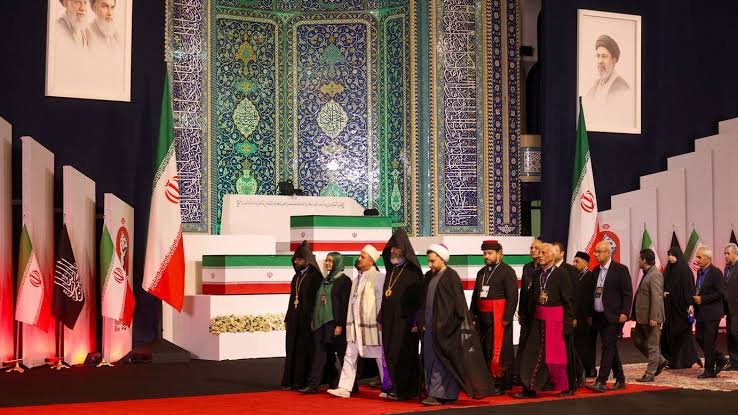
More than four months after a US and Israeli strike killed him, Iran finally buried Ayatollah Ali Khamenei on Thursday at the Shrine of Imam Reza in Mashhad, the city where he was born.
The Khamenei funeral was not a single event but a six-day national undertaking, moving across five cities in two countries and drawing some of the largest crowds the region has ever recorded. It closed one chapter of the Islamic Republic and opened an uneasy new one, with the man who is meant to lead it nowhere to be seen.
Here is what the Khamenei funeral revealed, what it means, and the question hanging over everything that comes next.
How Big Was the Khamenei Funeral?
Enormous, though the exact figure depends on who is counting.
Iranian state media reported that between 41 and 43 million people took part over the six days, with Press TV calling it the largest procession the world has ever witnessed. Independent estimates are far lower. The Financial Times reported that the government had prepared for 12 to 15 million domestic participants, and outside analysts put the total at more than 15 million, a figure that is itself extraordinary, and one the Iranian numbers roughly double.
Either way, the scale of the Khamenei funeral was deliberate. The government facilitated the event by providing transportation, food and lodging, and declared a national shutdown on 5 and 6 July. More than 4,700 foreign guests from 27 countries attended, including senior officials from Saudi Arabia, Pakistan, Russia, China, and Turkey.
A Procession Across Five Cities
The ceremonies began on 3 July at the Grand Mosalla religious complex in Tehran, where tens of thousands gathered around Khamenei’s coffin.
From there, the cortege moved through Qom, then crossed into Iraq, where Khamenei’s body was driven through Najaf and Karbala, two of the holiest cities in Shia Islam. Authorities in Karbala recorded the attendance of around seven million mourners, and the crowds were so large that the transfer back to Iran was delayed by several hours.
The timing carried its own weight. The funeral fell during Muharram, the Islamic month when Shia Muslims honor the martyrdom of Hussein at Karbala, the same site the coffin passed through. Fighter jets escorted the aircraft carrying the coffins back to Mashhad, where a helicopter lifted Khamenei’s casket over the crowd for the final stretch to the shrine.
Red Flags and Calls for Revenge
This was a burial, but it was also a rally.
Mourners carried red flags, which in Shia tradition symbolize the search for vengeance, alongside banners with explicit anti-Trump slogans. In Mashhad, crowds chanted that they would take revenge on the US president for Khamenei’s killing, while some held placards calling for his death. One giant banner near the shrine showed a caricature of the president with a bounty on his head. Another depicted Israeli Prime Minister Benjamin Netanyahu with the message, There will be blood.
The anger has a theological frame. Martyrdom holds a central place in Shia belief, and Khamenei’s death at the hands of foreign enemies has, in the words of one analyst, made him far more powerful symbolically in death than he was in life. The killing did not diminish him. It canonized him.
The Heir Nobody Can See
The most significant figure at the Khamenei funeral was the one who never appeared.
Mojtaba Khamenei, proclaimed supreme leader by a clerical assembly a week after his father’s death, has not been seen in public since the war began. No image, video, or voice recording of him has been released. Officials say he was wounded in the same 28 February strike that killed his father, with reports describing serious injuries, and that security services are limiting his exposure in case of further US attacks.
His absence is more than a footnote. A new supreme leader who cannot appear at his own predecessor’s funeral, and who governs only through written statements, is a leader whose authority is untested in public. Three of the late Khamenei’s sons attended, as did officials including parliament speaker Mohammad Bagher Ghalibaf, but the front row shown on state television was notably empty of the country’s most senior figures.
Why the Timing Matters
The funeral was originally scheduled for March. It was postponed for more than four months, and the delay tells its own story.
Iranian officials cited security concerns and the risk of attack, which is plausible given that the war has continued in fits and starts ever since. The burial ultimately coincided with a renewed burst of fighting: in the same week Iran laid its leader to rest, the US and Iran traded strikes, and President Trump declared their ceasefire over. The strikes were confirmed by US Central Command, which described its operations as a response to attacks on shipping in the Strait of Hormuz.
Whether the emotion channeled through these six days hardens into policy, or whether a wounded, invisible successor can hold the Islamic Republic together, is the question the Khamenei funeral leaves behind. The crowds have gone home. The war has not.
The renewed fighting that overshadowed the burial is examined in our coverage of What is left of the Iran ceasefire.
Follow NEWSCOUR for more updates!