
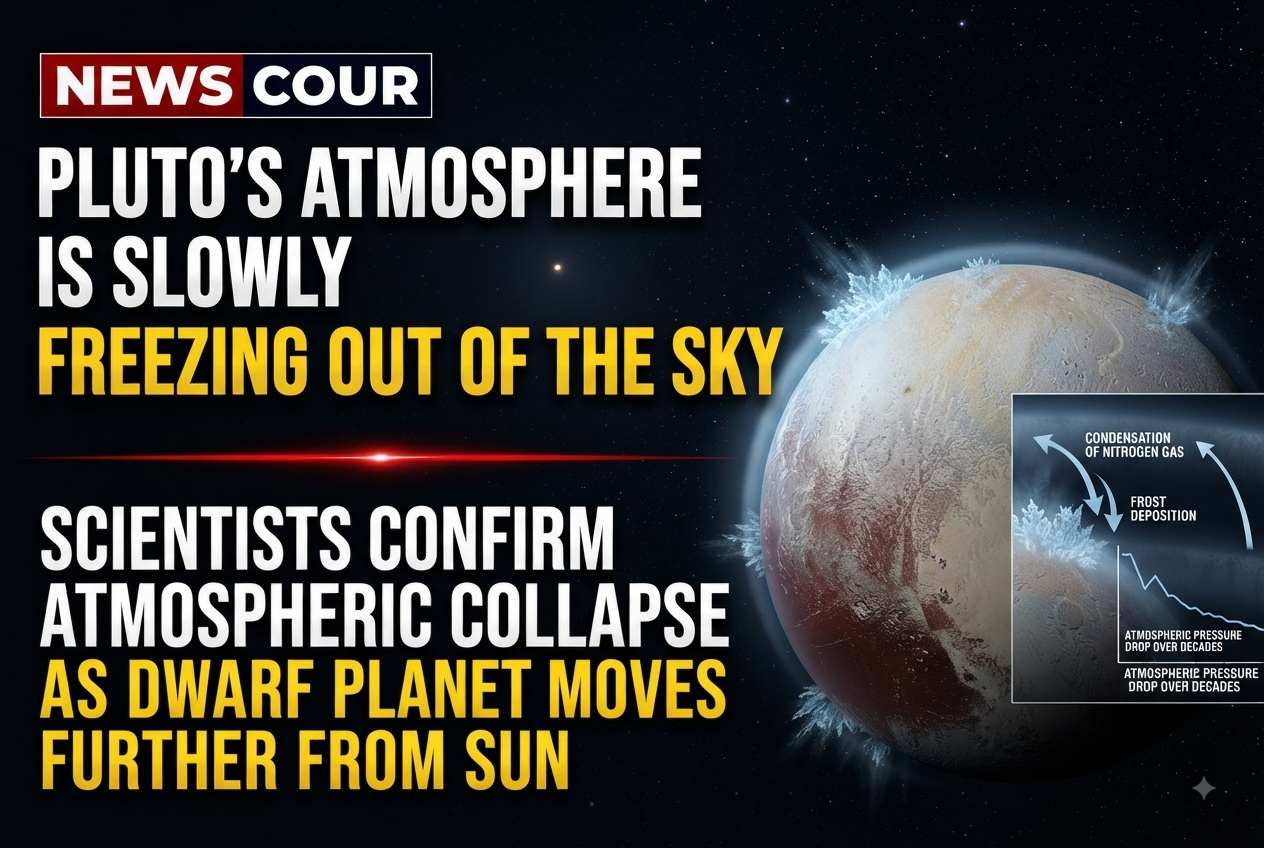
On the frozen edge of our solar system, a whole atmosphere is quietly disappearing. Pluto’s atmosphere, a thin veil of mostly nitrogen, is expected to grow steadily thinner over the coming decades and eventually freeze solid onto the surface.
The cause is Pluto’s long, looping journey around the sun. As the dwarf planet drifts into colder, darker regions of space, its air is turning to frost.
Here is what is happening to Pluto’s atmosphere, why it is tied to a 248-year orbit, and what it reveals about this distant world.
What Is Happening to Pluto’s Atmosphere
Pluto does not hold onto its atmosphere the way Earth does. Its thin envelope of gas exists in a delicate balance with the ice on its surface, and that balance depends almost entirely on temperature.
When Pluto is warmer, surface ices turn directly into gas and thicken the atmosphere. When it cools, the process reverses and the gas freezes back onto the ground as frost.
A Balance Tied to Temperature
The key points scientists highlight about this cycle are:
- Pluto’s atmosphere is made mostly of nitrogen, with traces of methane and carbon monoxide.
- The gas is fed by surface ices that sublimate, or turn straight from solid to vapor.
- As temperatures fall, that vapor refreezes, thinning the atmosphere.
- Over the coming decades, the atmosphere is expected to largely freeze out.
Why Pluto’s Long Orbit Drives the Change
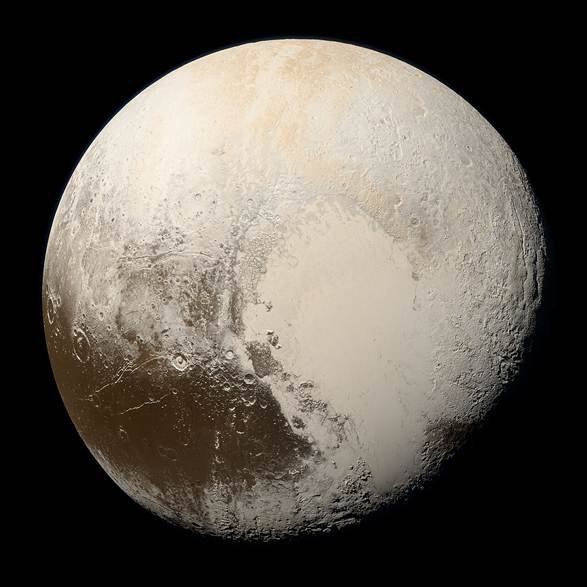
Pluto takes about 248 Earth years to circle the sun once, on a path that is far more stretched and tilted than the orbits of the major planets. That means the distance between Pluto and the sun changes dramatically over its year.
For the next 88 years or so, Pluto will be traveling through colder, darker parts of the outer solar system. Less sunlight means lower temperatures, and lower temperatures mean more of the atmosphere condensing back onto the surface.
The thinning of Pluto‘s atmosphere is not a sudden event but a slow, gradual shift. The change will play out across decades, a single season in the long calendar of a Plutonian year.
What It Tells Us About Distant Worlds
Pluto is a natural laboratory for how thin atmospheres behave at the solar system’s frigid edge. Watching its air freeze and thaw helps scientists understand similar processes on other icy bodies.
It also reshapes how we picture Pluto itself. Far from being a static ball of ice, it is a dynamic world with seasons, weather and an atmosphere that breathes in and out over centuries.
Studying these changes largely depends on data gathered when spacecraft and telescopes catch Pluto at different points in its orbit. Each observation adds a frame to a movie that takes lifetimes to play.
Distant as it is, Pluto is part of the same solar system we watch from home. For a closer-to-home sky event, see our guide to the total solar eclipse crossing Europe on August 12.
For now, Pluto continues its slow drift outward, its sky thinning by imperceptible degrees. By the time its atmosphere returns in full, generations of humans will have come and gone.
The outer solar system still hides plenty of surprises, and Pluto keeps proving it deserves our attention. For more discoveries from across the cosmos, stay with NEWSCOUR.