
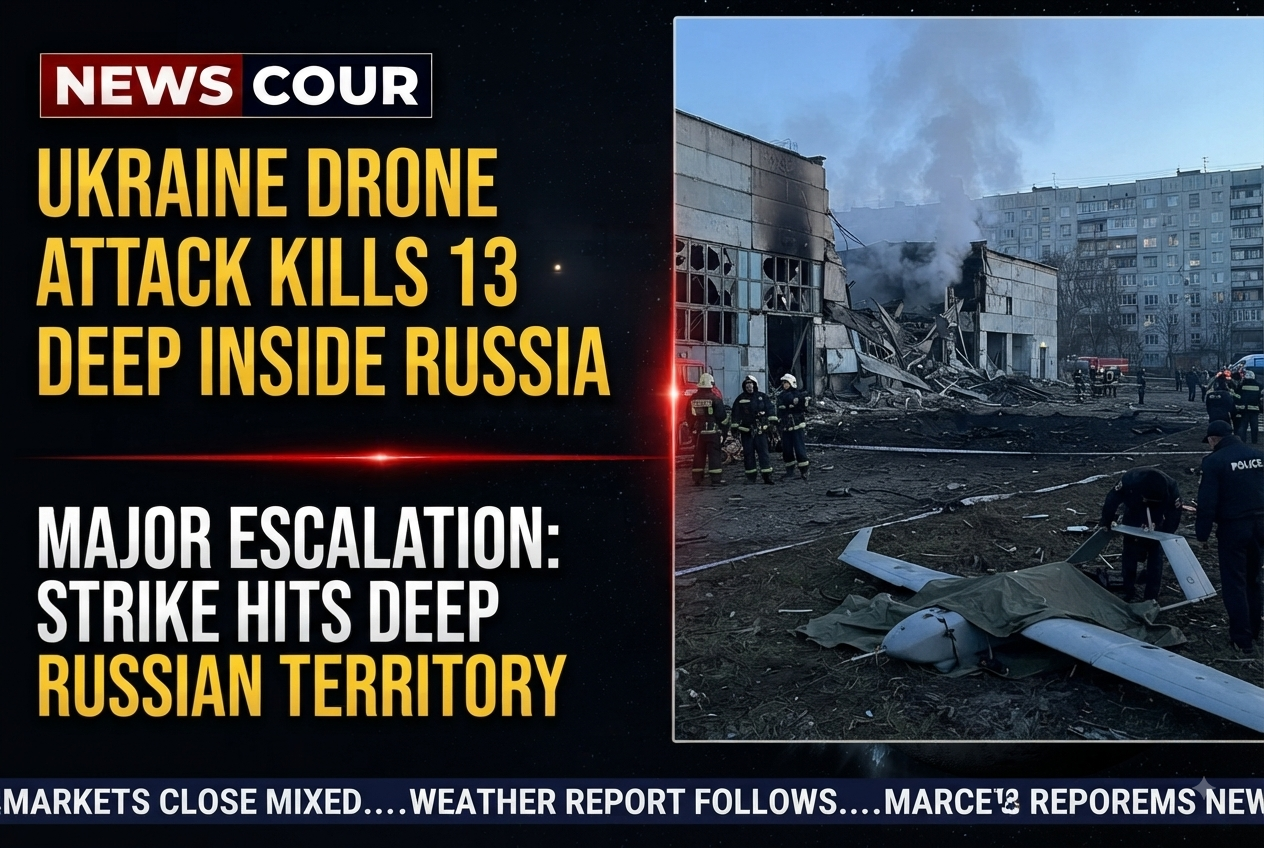
A Ukraine drone attack has struck one of Russia’s largest oil refineries deep in the republic of Tatarstan, killing at least 13 people, including a child, and wounding 75 others. The strike on the city of Nizhnekamsk on Monday was among the deadliest inside Russia in the four-year war.
The Ukraine drone attack targeted a site roughly 750 miles from the border, one of the longest-range blows Kyiv has landed. Ukraine’s military said it hit the TANECO oil refinery, and a fire was recorded at the plant.
Here is what happened in Nizhnekamsk, why Ukraine keeps striking Russian oil sites, and what it means for a war that keeps reaching farther from the front.
What Happened in the Ukraine Drone Attack
Just after dawn on Monday, air-raid sirens and the drone of engines reached a city most of the war had never touched. By mid-morning, one of Russia’s most advanced refineries was ablaze.
Russian authorities in Tatarstan said the Ukraine drone attack struck industrial and civilian sites across Nizhnekamsk, a city of about 240,000 people. Regional head Rustam Minnikhanov denounced the attack as barbaric and declared a day of mourning.
The Confirmed Toll
According to regional officials and international agencies, the established facts are:
- At least 13 people were killed, including a child, with several outlets citing a range of 12 to 13.
- Around 75 people were wounded, in one of the heaviest civilian tolls inside Russia in months.
- One drone hit a hostel, killing nine of the victims, seven of them citizens of Uzbekistan.
- Ukraine’s General Staff said it struck the TANECO refinery, part of the Tatneft group, and confirmed a fire.
Both Kyiv and Moscow say they do not target civilians, and it was not possible to independently verify either side’s account of the strike. Russian investigators said they had opened a criminal case, describing it as a terrorist attack.

Why the Ukraine Drone Attack Hit an Oil Site
The refinery was no accidental target. Ukraine has hit Russian oil facilities with long-range drones almost daily in recent months, in a deliberate campaign against the fuel that funds and moves the Russian war machine.
The strategy has bitten. The barrage has caused fuel shortages in Russia, eaten into its refining capacity and unsettled the public, and repairs are slow because the damaged equipment is often imported and hard to replace under sanctions.
President Volodymyr Zelensky framed it as leverage rather than revenge, saying the goal is to force Russia to the negotiating table. Russia’s war will be felt more and more at their own home, he said, casting the strikes as a justified response to relentless Russian attacks on Ukrainian cities.
A War Reaching Ever Farther
The Ukraine drone attack is part of a pattern of the conflict spilling far beyond the front line. Ukraine’s domestically built long-range drones have flown increasing distances into Russia, with some now reaching Siberia, roughly 1,200 miles from the border.
The same 24 hours showed the war’s grinding cost on both sides. Russian strikes on the Ukrainian cities of Kharkiv and Zaporizhzhia killed and wounded civilians, and the World Health Organization said one of its warehouses in Ukraine’s Dnipro region was hit twice, destroying an estimated $500,000 in medical supplies, a loss it detailed through the World Health Organization.
With diplomacy stalled, both capitals appear to be betting that pressure, not talks, will shape the war’s next phase. Each deep strike raises the stakes and the risk to civilians far from the trenches.
This deep-strike campaign follows the same thread as Russia’s own cross-border incidents. For a related case, see our report on the Russian drone that landed in Moldova.
For the people of Nizhnekamsk, a city that had watched this war from a safe distance for years, Monday was the morning the distance vanished. The front line, it turns out, can arrive by air at any address.
The war is being fought farther from its front lines than ever, and each long-range strike widens the danger. For verified updates as officials confirm the toll, stay with NEWSCOUR.