
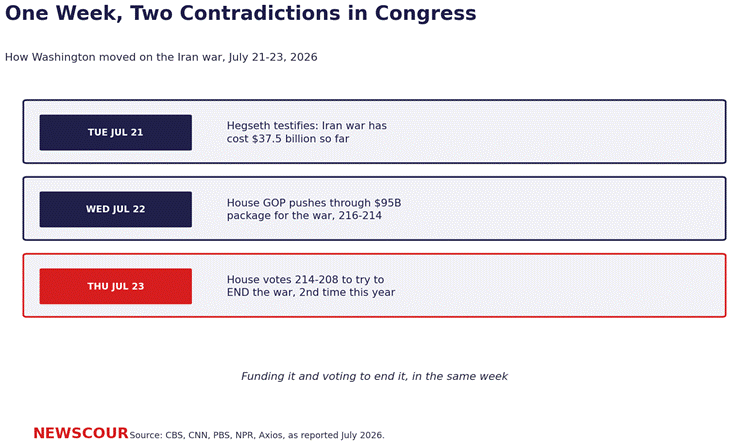
The Iran war funding fight became impossible to ignore this week, as Defense Secretary Pete Hegseth told senators the conflict has cost $37.5 billion so far, House Republicans muscled through a $95 billion budget package to keep it running, and then, two days later, the House voted 214 to 208 to direct the president to pull US forces out of the fighting. Four Republicans crossed over to join every Democrat on that vote. It was the second time this year the House has taken that step, and it changed nothing about the war on the ground.
Here is what Washington actually did this week, why the numbers keep multiplying, and why none of it may matter to how the war proceeds.
What the Iran War Funding Fight Actually Cost So Far
Hegseth’s figure, delivered under questioning at a Senate Appropriations Committee hearing Tuesday, was blunt: $37.5 billion spent since the fighting resumed, though sources briefed on the accounting told CBS News the real total is likely higher once every operational cost is folded in. The administration’s supplemental request, first sent to Congress in June, asks for roughly $87 billion overall, including $67 billion earmarked directly for the conflict and military resupply, alongside unrelated add-ons like farm aid and funding for the Ebola response in Central Africa that have drawn criticism from Democrats for muddying an already difficult vote.
Senators on both sides pressed for specifics. Republican John Kennedy of Louisiana said Congress and the public deserved straighter answers about the endgame, while Democrat Dick Durbin said the Pentagon still had not justified the cost. Nearly 100 American service members have been injured in Iranian strikes on regional bases this month alone, and Trump’s attendance this week at the dignified transfer of four more fallen troops brought the military death toll in the conflict to 18.
How the Iran War Funding Package Passed Anyway
Wednesday brought the funding side of the story. House Speaker Mike Johnson pushed a Republican-only $95 billion budget package through on a party-line 216-to-214 vote, bundling Iran war money with other White House priorities, including provisions tied to Trump’s SAVE America Act. No Democrats voted for it, and even some conservative Republicans were uneasy, since the package includes no offsetting spending cuts. Budget Committee chair Jodey Arrington of Texas summed up the GOP argument bluntly, describing the money as bullets and bombs to finish the job. The House separately passed a sprawling $1.15 trillion defense bill Tuesday that tucks in tens of billions more for the war, though the Senate has not yet taken it up.
Then came Thursday’s reversal. The same chamber that had just voted to fund the war voted to end it, approving a war powers resolution 214 to 208 that directs the removal of US forces from hostilities with Iran. Republican Reps. Brian Fitzpatrick, Tom Barrett, Warren Davidson and Thomas Massie joined every Democrat, the same four who crossed over on a similar measure in June. Congressional records show it is the second such rebuke this year, and like the first, it carries no legal force.
Why the Iran War Funding Votes Do Not Stop the War
The mismatch is built into the process. Both this week’s resolution and June’s version passed as measures that do not require the president’s signature, and because they lack the force of law, Trump can simply ignore them, as he has ignored the earlier one. Even if a version were passed as a binding joint resolution, Trump could veto it, and overriding that veto would need a two-thirds vote in both chambers, a bar neither vote came close to clearing. Congress has also never formally authorized the war in the first place, leaving lawmakers able to criticize it but not to legally stop it.
That leaves the funding fight as the only lever with real teeth, and Republicans control it. A recent AP-NORC poll found most Americans disapprove of the administration’s Iran strategy, but disapproval has not translated into the votes needed to cut off money for a war already in its fourth month since the June ceasefire fell apart.
What Happens Now
The Senate has not yet acted on either the $1.15 trillion defense package or a matching war powers measure, and Senate Democratic leader Chuck Schumer has said Democrats will force another such vote there. Until the Senate moves, the practical outcome of this week’s Iran war funding fight is that the war continues, fully funded and formally condemned by the same Congress, at the same time.
Follow NEWSCOUR for more updates!