
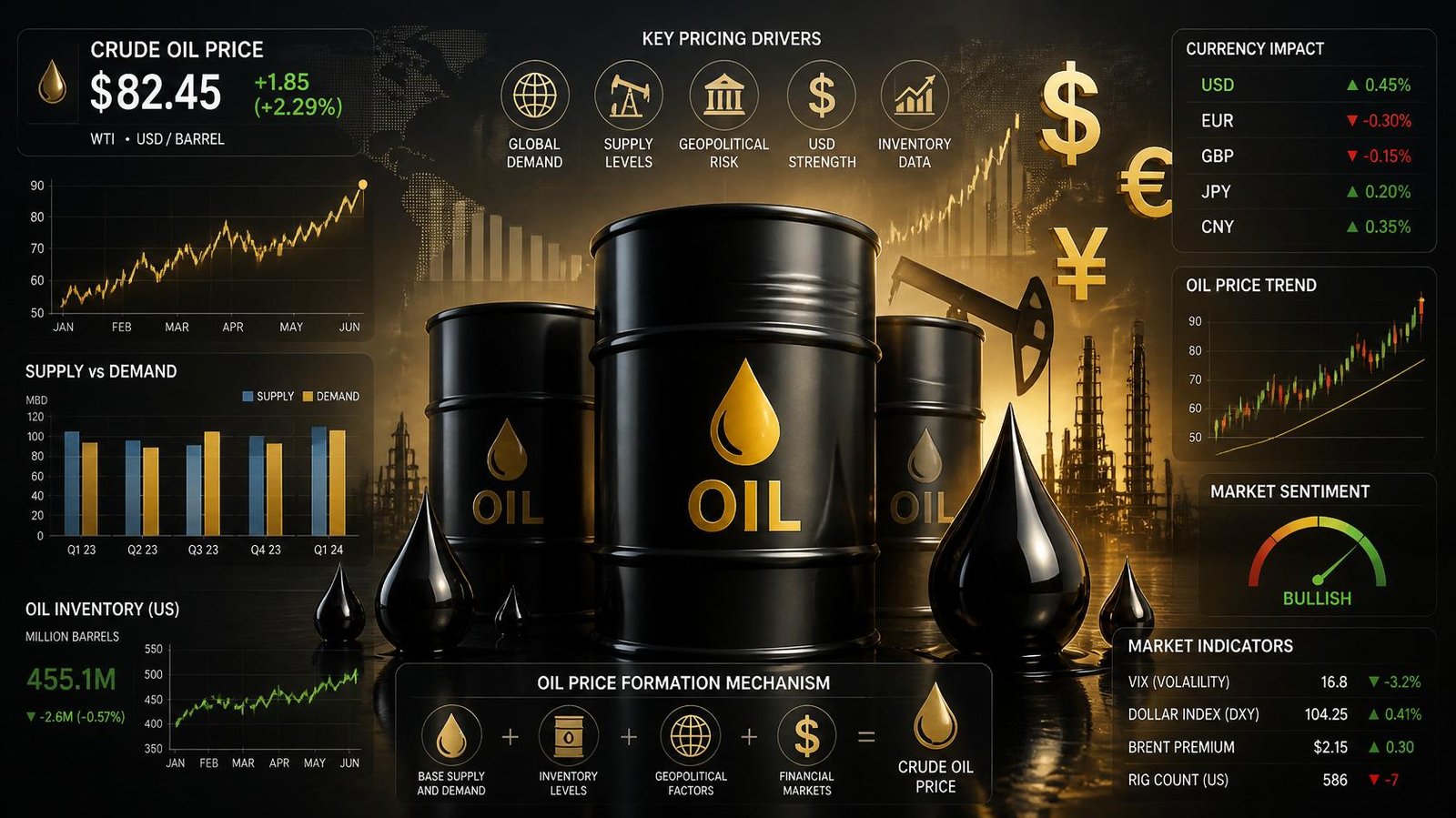
Quick Answer: Oil is priced through live global trading on futures exchanges, anchored by three main benchmark grades: Brent crude, West Texas Intermediate (WTI), and Dubai/Oman. OPEC+ production decisions, geopolitical shocks, U.S. dollar strength, and weekly supply data all push prices up or down daily. No single body sets the price. It emerges from the market, continuously, around the clock. Interestingly, any news update from any corner of the world impacts the price.
Most people have a rough idea that oil prices come from somewhere in the Middle East, involving people in suits arguing about barrels. That picture is not entirely wrong. But it leaves out most of what actually happens. The price of crude oil is the output of one of the largest, most politically sensitive markets on earth, and the way it works is genuinely worth understanding.
Here is how it actually gets set.
What Are the Key Facts About Oil Pricing? How Is Oil Priced?
- Brent crude is the primary global oil benchmark, used to price crude across Europe, Africa, and Asia
- WTI is the main benchmark for North American markets, traded on the New York Mercantile Exchange
- OPEC+ controls approximately half of global crude oil production
- Brent crude averaged $69 per barrel in 2025, per the EIA May 2026 Short-Term Energy Outlook
- U.S. crude oil production hit a record 13.6 million barrels per day in 2025, according to the same EIA report
- Nearly 20% of global oil supply transited the Strait of Hormuz before the February 2026 conflict disrupted shipping flows (EIA)
There Is No Single “Oil Price”
This surprises people. They hear “oil is at $70 a barrel” and assume there is one fixed number. There is not. Crude oil comes in different grades based on density and sulfur content. Light, sweet crude is easier to refine into fuel, so it commands a higher price. Heavy, sour crude takes more work and sells cheaper. Location matters too. A barrel sitting in a landlocked field in Oklahoma is worth less than the same grade of oil sitting on a tanker already at sea, because transport costs are built into the price.
That is why benchmarks exist. They give buyers and sellers a common reference point, adjusted for quality and delivery location.
How Oil Actually Gets a Price: Spot Markets and Futures
Oil trades in two ways.
In the spot market, crude changes hands for immediate delivery at whatever the going rate is that day. In the futures market, contracts are bought and sold for oil to be delivered weeks or months from now. Futures are what most people are watching when they check the oil price. The front-month futures contract, the one expiring soonest, is what gets reported in the news.
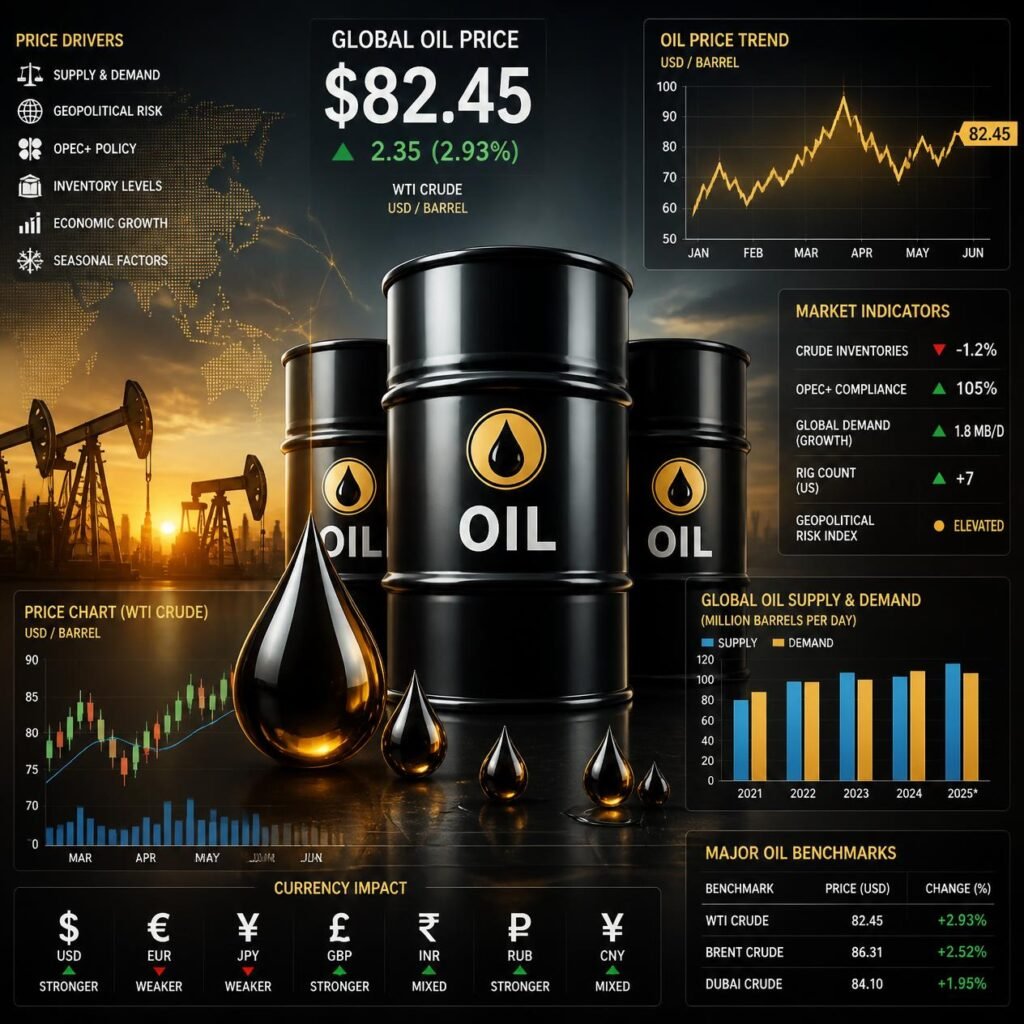
Two types of people trade in the futures market. Refineries and oil companies use it to lock in prices and manage their costs. If you run a refinery, you do not want to guess what crude will cost six months from now. You buy a contract to lock it in. Then there are investors and traders with no interest in physical oil at all. They are just making bets on price direction. Both groups are trading the same contracts, which is part of why oil prices can move on news that has nothing to do with actual barrels.
The spot price and the futures price tend to stay close together under normal conditions. When they diverge sharply, it usually signals something unusual is happening in physical supply.
The Three Benchmarks That Run the Global Oil Market
| Benchmark | Source Region | Primary Use | Exchange |
| Brent Crude | North Sea | Europe, Africa, Asia | ICE |
| WTI | U.S. oil fields | North America | NYMEX |
| Dubai/Oman | Persian Gulf | Asian imports | DME |
Brent is the dominant global reference. Prices are assessed daily by S&P Global based on physical cargo transactions, which keeps it grounded in real deals rather than speculation alone. Brent futures trade on the Intercontinental Exchange (ICE) in London.
WTI is priced at Cushing, Oklahoma, the main U.S. pipeline hub. It typically trades at a small discount to Brent because it is landlocked, which makes it harder and more expensive to move to ports. The shale boom of the 2010s made WTI much more relevant globally, though Brent still prices more of the world’s crude.
Dubai/Oman covers heavier, higher-sulfur Persian Gulf crude heading to Asian refiners in China, Japan, South Korea, and India. Most of what flows out of the Gulf to Asia is priced against this benchmark.
Oil-producing countries set their export prices by taking one of these benchmarks and adding or subtracting a differential based on their crude quality and where it is going. That is how a barrel from Nigeria or Iraq gets a price without having its own independent market.
What Actually Moves the Price
OPEC+ and Production Quotas
The Organization of the Petroleum Exporting Countries and its allied producers, collectively known as OPEC+, control roughly half of global crude supply. When the group decides to cut production, less oil reaches the market and prices tend to rise. When it increases output, the opposite happens.
Saudi Arabia functions as what analysts call the swing producer. It has the capacity to raise or lower output relatively quickly and has historically been willing to use that flexibility to manage prices. OPEC+ meets regularly to review quotas, and those meetings move markets before they even conclude.
Geopolitical Shocks
No factor causes sharper, faster price moves than a threat to physical supply. The Strait of Hormuz is a narrow waterway between Iran and Oman through which, according to the EIA’s May 2026 Short-Term Energy Outlook, nearly 20% of global oil supply flowed before conflict disrupted traffic in late February 2026. Brent averaged $71 per barrel in February that year and $117 per barrel by April, per the same EIA report. That kind of move in eight weeks is not driven by demand. It is driven by fear about whether the barrels will actually show up.
Wars, sanctions, pipeline explosions, and political instability in producing countries all create the same kind of anxiety in the market.
The U.S. Dollar
Oil is priced in U.S. dollars globally. When the dollar weakens, oil becomes cheaper for buyers using other currencies, which tends to lift demand and push prices up. A strong dollar makes oil more expensive for non-U.S. buyers, which tends to dampen demand and pull prices down. This is why oil sometimes moves when the Federal Reserve makes an interest rate decision, even when nothing in the oil market itself has changed.
Weekly Inventory Data
Every week, the American Petroleum Institute publishes U.S. oil inventory figures on Tuesday. The EIA follows with its own report on Wednesday. These reports tell the market whether supply is building up or getting drawn down. A surprise build means there is more oil than expected, which pushes prices lower. A surprise draw means demand is pulling through supply faster than anticipated, which pushes prices up. Traders watch both numbers closely every single week without exception.
U.S. Shale Production
Before the American shale revolution, OPEC+ had far more pricing power. The U.S. became the world’s largest crude oil producer, with output reaching a record 13.6 million barrels per day in 2025 according to EIA data. That volume competes directly with OPEC barrels and limits how far the group can push prices before American producers start adding supply to take advantage.
How the Crude Price Gets to Your Pump
The benchmark price is step one. After that, crude has to be refined into gasoline, diesel, or jet fuel. Refining costs, distribution, retail margins, and taxes all stack on top. According to the EIA and the American Petroleum Institute, crude oil represents roughly half the retail price of a gallon of gasoline, which is why pump prices move in the same direction as Brent or WTI, though not always by the same amount or at the same speed.
The effect spreads well beyond fuel. Airlines, food producers, freight companies, and manufacturers all carry energy costs in their pricing. A sustained rise in crude typically shows up in grocery bills, shipping rates, and airfares within weeks. There is almost no sector of a modern economy that does not eventually feel a big swing in oil prices.
Countries that depend on oil revenue for their government budgets feel it even more directly. For a closer look at how hydrocarbon wealth shapes national economies, see our piece on Azerbaijan: Rich in Hydrocarbons and Global Energy Influence, which covers exactly that dynamic.
For authoritative, regularly updated data on crude oil market drivers, the EIA’s crude oil market overview is the best free resource available.
Frequently Asked Questions
Who decides the price of oil?
Nobody decides it. It emerges from continuous trading on global futures exchanges, shaped by supply and demand, OPEC+ quotas, geopolitical events, currency movements, and weekly inventory data. There is no room where someone sets the number.
What is the difference between Brent and WTI crude?
Brent comes from the North Sea and is the primary international benchmark. WTI comes from U.S. oil fields and is the main reference for North American markets. Both are light, sweet grades. WTI usually trades at a small discount to Brent because of its landlocked delivery point in Oklahoma.
Why does the oil price change every single day?
Because it is traded on financial exchanges that react in real time to news. An OPEC announcement, a conflict near a major shipping route, a surprise in U.S. inventory data, or a shift in the dollar can all move the price within minutes. Oil is never truly at rest.
How does OPEC affect oil prices?
By controlling how much crude member countries pump. Cut the supply, prices rise. Raise it, prices fall. Saudi Arabia, with the most flexible production capacity in the group, tends to have the biggest individual influence on collective decisions.
Why did oil prices spike in early 2026?
Military action beginning February 28, 2026, disrupted shipping through the Strait of Hormuz, which carried nearly 20% of global oil supply. The Brent spot price went from an average of $71 per barrel in February to $117 per barrel by April, according to the EIA May 2026 Short-Term Energy Outlook.