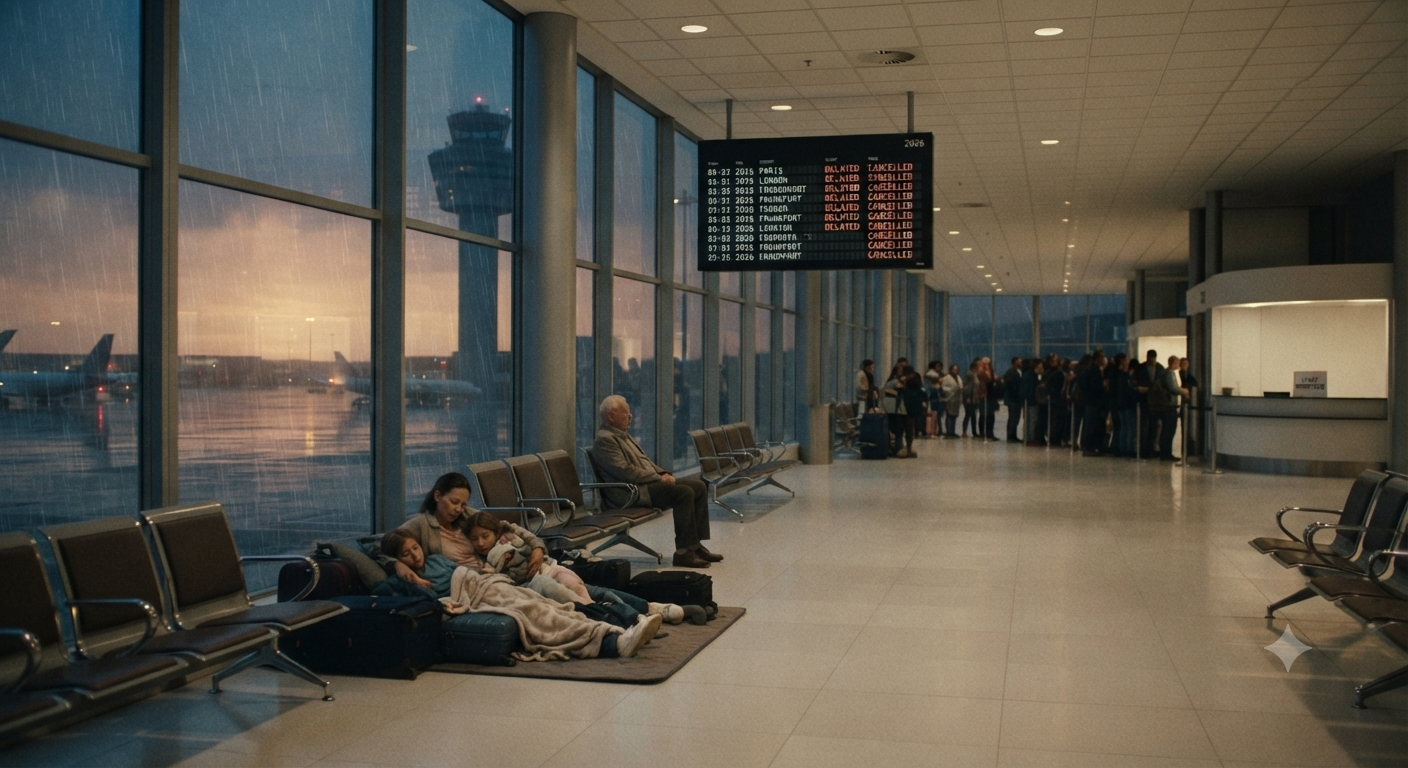
If your flight has run late this month, you are not imagining a worse summer than usual. The numbers back you up.
Flight disruptions 2026 have piled up across US airports at a pace that stands out even by the standards of a chaotic peak travel season, with more than 1,475 cancellations logged in July alone and thousands of delays stacking on top of them. The FAA’s own daily advisory on Tuesday flagged likely storm delays at airports stretching from Boston and New York to Atlanta, Chicago, Denver and Las Vegas, a reminder that this is not a one-city problem. Behind the headline weather delays sits a second, quieter cause that has been building for years and shows no sign of resolving before Labor Day.
Here is what is actually driving the disruption, which airports are hit hardest, and what travelers can do about it.
The Two Forces Behind 2026’s Flight Disruptions
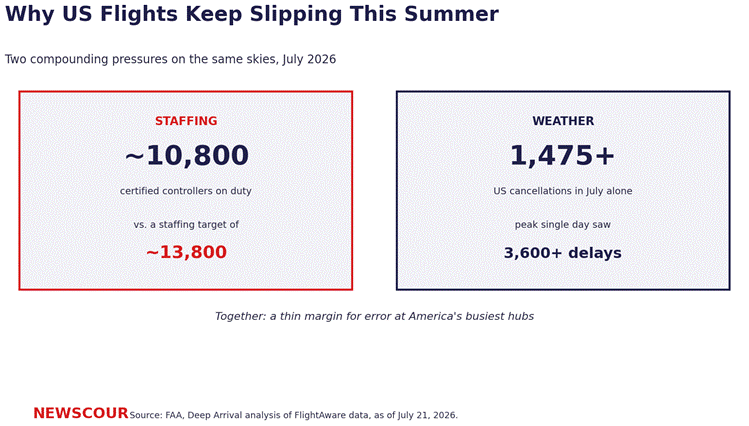
Ask an airline, and you will hear about the weather. Severe thunderstorms have repeatedly triggered ground stops this month at some of the country’s busiest hubs, including Charlotte Douglas, San Francisco, JFK and Washington Dulles, and a single mid-July storm system over Texas and the East Coast produced more than 3,600 delays and 80-plus cancellations in one day.
But weather alone does not explain why flight disruptions 2026 keep happening on clear-sky afternoons. The FAA is running with roughly 10,800 fully certified air traffic controllers against an internal staffing target of about 13,800, a shortfall of nearly 3,000 positions, or close to one in five posts unfilled. When a facility is short-staffed, the agency slows the flow of aircraft to keep operations safe, and that shows up at the gate as a delay with no cloud in sight. On July 17, Chicago O’Hare alone logged 3,195 delays and 141 cancellations from a combination of the controller gap, Canadian wildfire smoke over Washington, and ordinary summer storms.
Is Anyone Fixing the Staffing Gap
The Department of Transportation says yes, and points to real movement. Transportation Secretary Sean Duffy has run a hiring push since taking office, including a campaign aimed at recruiting video gamers into the control tower pipeline, and the Federal Aviation Administration reported in April that staffing had reached its highest level in six years, with almost 11,000 controllers in service and more than 4,000 more in training. The agency has also streamlined its hiring process, cutting months off the path from application to academy.
The catch is time. Training a controller to full certification takes years, not months, so even a successful hiring surge shows up in the numbers gradually while the summer travel surge is happening now. Independent tracking still puts the working gap near 3,000 positions as of this month, which is the number showing up in delay boards at JFK, LaGuardia, Newark and O’Hare.
Which Airports and Days Are Worst
Delays cluster in predictable ways. Weekends and Mondays see the sharpest spikes, when leisure and business travel overlap and even a routine afternoon thunderstorm can take hours to unwind into. The New York area airports, Chicago O’Hare, Atlanta, and the Texas and Mid-Atlantic corridors have absorbed the heaviest hits this month, and government rules require airlines to update public flight status within 30 minutes of a cancellation or significant delay becoming known, which is the fastest reliable signal travelers have.
Forecasters expect little relief soon. Late July and early August typically bring the most intense convective storm activity of the year across the central and eastern US, meaning flight disruptions 2026 totals are more likely to climb than fall before the peak season ends.
What Travelers Can Actually Do
Book early departures where the schedule allows one, since morning flights are least likely to inherit a delay chain built up over the day. Build real buffer time into connections rather than the minimum layover, and use an airline’s rebooking app the moment a cancellation posts rather than waiting in a terminal line. None of that fixes the staffing gap driving flight disruptions 2026 has become known for, but it is the difference between a stressful travel day and a lost one.
Follow NEWSCOUR for more updates!