
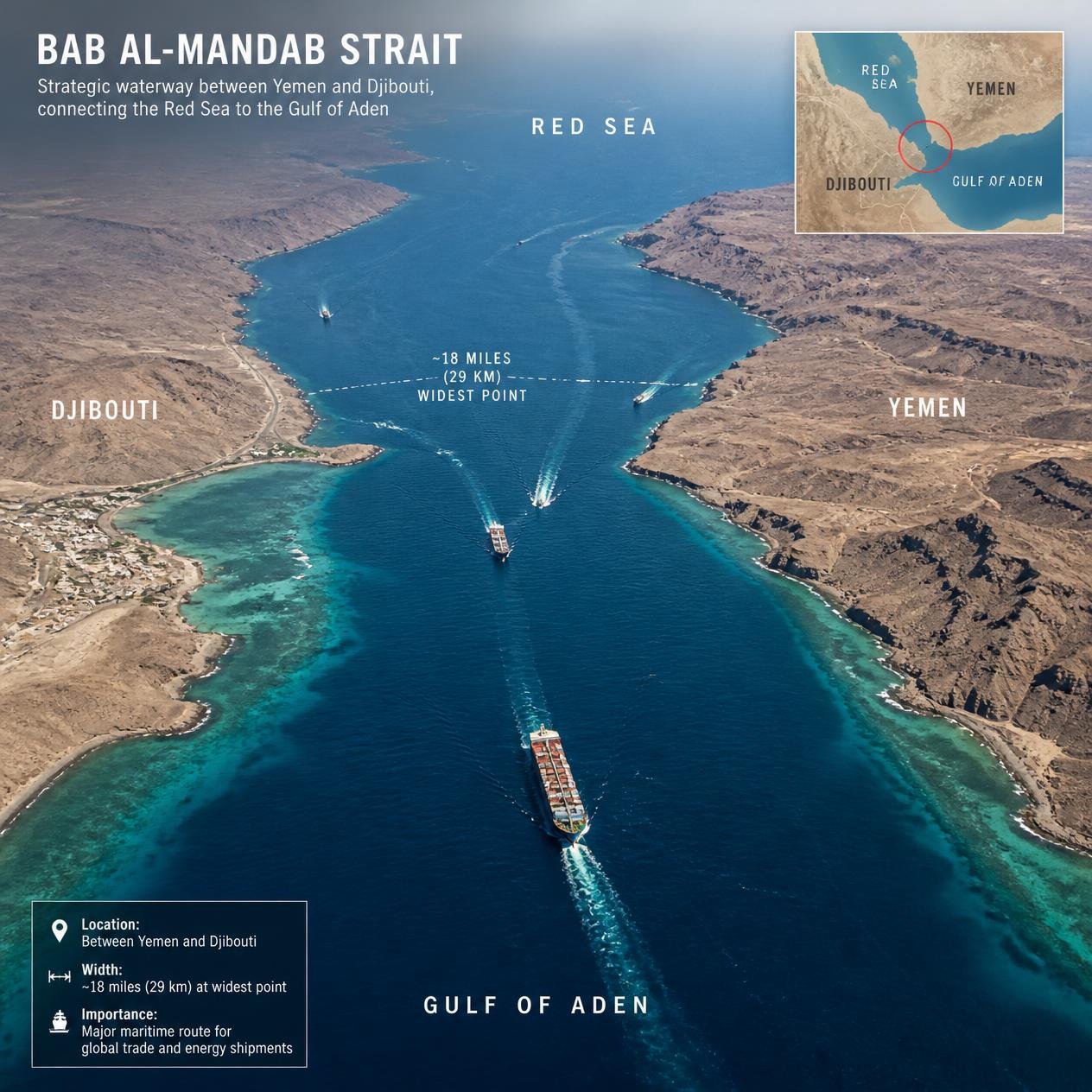
The strait is a chokepoint. That is the technical term for a narrow passage on a major shipping route where geography creates an unavoidable bottleneck.
Most people have never heard of Bab El Mandeb, the Strait. That is about to change. In early April 2026, as Iran effectively closed the Strait of Hormuz and senior Iranian advisers publicly threatened to extend that blockade to a second waterway, the name “Gate of Tears” started appearing in energy market reports, Pentagon briefings, and newspaper front pages simultaneously.
This is not a new flashpoint. It is a very old one that the world keeps forgetting about until it cannot afford to anymore.
What Is Bab El Mandeb and Where Is It Located?
Bab El Mandeb is a narrow strait at the southern end of the Red Sea, connecting it to the Gulf of Aden and from there to the Indian Ocean. It sits between Yemen on the Arabian Peninsula to the northeast and the East African nations of Djibouti and Eritrea to the southwest.
The name comes from Arabic. “Bab” means gate or door. “Mandab” means lamentation or grief. Together it translates as the “Gate of Tears” or “Gate of Grief.” The name is ancient and earned. The strait’s crosscurrents, unpredictable winds, reefs, and shoals wrecked ships for centuries before modern navigation made safe passage more reliable, according to National Geographic.
At its narrowest point the strait is approximately 30 kilometers wide, according to The Conversation. It is divided into two channels by Perim Island, known also as Mayyun Island. The western channel is about 26 kilometers across and is the lane used by large commercial vessels and oil tankers. The eastern channel, called Bab Iskender, is around 3 kilometers wide and much shallower, used mainly by local traffic.
Why Bab El Mandeb Matters to Global Trade
The strait is a chokepoint. That is the technical term for a narrow passage on a major shipping route where geography creates an unavoidable bottleneck. There are eight major maritime chokepoints in the world. Bab El Mandeb is one of them and arguably the one that has caused the most disruption to global trade in the past two years.
Its importance comes directly from its position in the chain between the Indian Ocean and the Mediterranean Sea. Ships traveling from Asian ports or from the Persian Gulf heading to Europe do not go around Africa if they can help it. They go north through the Gulf of Aden, through Bab El Mandeb, up the Red Sea, through the Suez Canal, and into the Mediterranean. An oil tanker leaving Saudi Arabia for the Netherlands covers roughly 12,000 kilometers via this route. Going south around the Cape of Good Hope adds more than 8,000 kilometers to that journey, according to The Conversation.
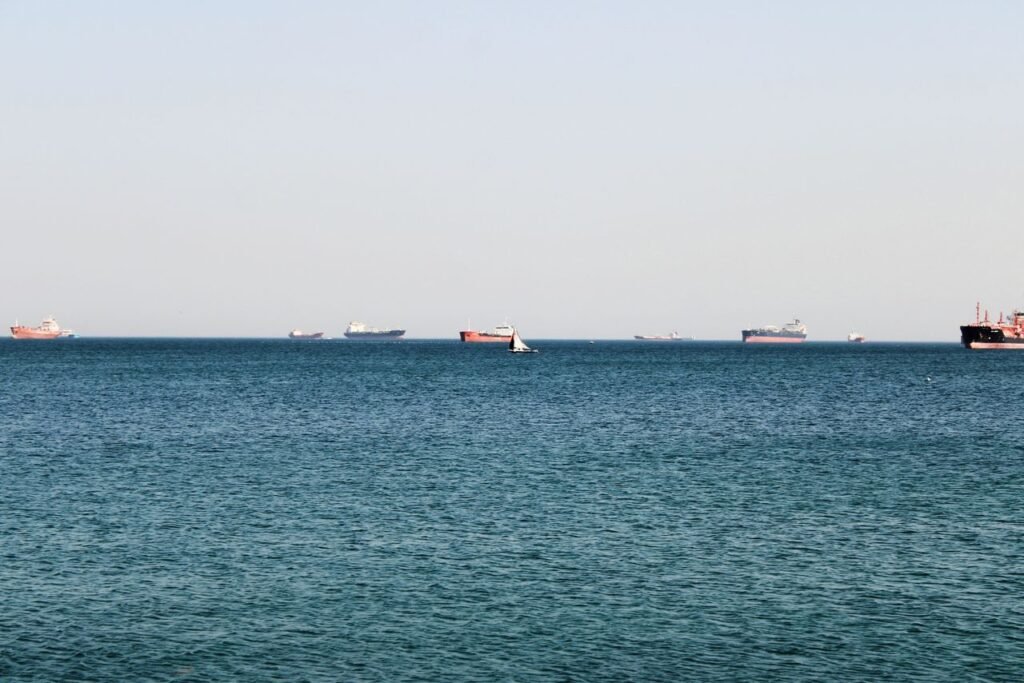
The Suez Canal route only works if Bab El Mandeb is open. Close the strait and you close the canal route as a practical option for most of the world’s largest vessels.
How Much Oil and Trade Passes Through Bab El Mandeb?
The numbers are significant enough to explain why multiple governments maintain naval forces in the area at all times.
According to Britannica, Bab El Mandeb accounts for roughly one-tenth of global seaborne oil trade, making it the third busiest chokepoint for oil after the Strait of Malacca and the Strait of Hormuz. Around one-quarter of global container trade also passes through it.
The International Energy Agency estimated that in 2025 approximately 4.2 million barrels of crude oil and petroleum liquids crossed Bab El Mandeb per day, equal to around 5 percent of global daily production, according to The Conversation. Before the Houthi attacks on Red Sea shipping began in late 2023, the US Energy Information Administration reported that 12 percent of world oil shipments passed through the strait in the first half of that year.
In the final quarter of 2025, around 40 percent of the 3,426 ships that passed through the Suez Canal were oil tankers or liquefied natural gas carriers. Bulk cargo, container ships, and agricultural commodity vessels made up most of the rest.
If Bab El Mandeb closes, those ships reroute. The global shipping system does not stop. It gets significantly more expensive and slower.
The Houthi Attacks and the 2023 to 2025 Red Sea Crisis
Understanding the current threat to Bab El Mandeb requires understanding what the Houthis did to it between late 2023 and 2025.
The Houthis are a Yemeni military and political movement that controls large parts of northern Yemen and is backed by Iran. After Israel launched its military campaign in Gaza following the Hamas attacks of October 7, 2023, the Houthis began attacking commercial ships in the Red Sea and the Gulf of Aden. They framed the attacks as a form of economic pressure in solidarity with Palestinians in Gaza.
Between November 2023 and September 2024, the International Maritime Organization recorded 67 separate incidents involving ships in the area. Some suffered only minor equipment damage. Others were hit by drones or missiles and sustained severe structural damage, flooding, and fires, according to The Conversation.
The impact on global shipping was immediate and measurable. Traffic through the strait fell below half its normal capacity. Major shipping companies rerouted vessels around the Cape of Good Hope, adding days and significant cost to journeys. In 2023, around 26,000 ships transited through the Suez Canal. By 2025 that number had dropped to approximately 12,700, according to the Suez Canal Authority data cited by Al-Monitor.
A ceasefire between the US and the Houthis in May 2025 paused the attacks. But shipping volumes had not significantly recovered by early 2026, partly because commercial insurers remained reluctant to cover vessels transiting the region without certainty that the ceasefire would hold.
Bab El Mandeb in 2026: The Current Threat
The situation intensified sharply in late March and early April 2026 following the outbreak of the broader US-Israel conflict with Iran. With Iran effectively closing the Strait of Hormuz to US and Israeli-linked vessels and threatening wider disruption, senior Iranian advisers publicly signaled that Bab El Mandeb was in play.
Ali Akbar Velayati, a former Iranian foreign minister and close adviser to the Supreme Leader, posted on X that “the unified command of the Resistance front views Bab El Mandeb as it does Hormuz,” according to Al Jazeera. The Houthis had already fired missiles toward Israel in late March 2026, their first attacks since the May 2025 ceasefire.
Analysts noted that Saudi Arabia, anticipating disruption at the Strait of Hormuz, had already activated its East-West pipeline at near full capacity, pumping oil from Abqaiq in the east to the Red Sea port of Yanbu. But oil exported from Yanbu still needs to pass through Bab El Mandeb to reach Europe and Asia without going around Africa. The pipeline’s existence does not eliminate the vulnerability, it just shifts where it sits geographically, according to The Conversation.
If both Bab El Mandeb and the Strait of Hormuz were simultaneously disrupted, analysts estimated that a quarter of the world’s entire energy supply would be effectively blocked, according to Al Jazeera.
The region is already one of the most heavily militarized maritime zones on earth. The US-led Combined Maritime Forces, established in 2002 and supported by 46 countries, operates in the area through Combined Task Force 153, which was specifically created in April 2022 to manage maritime security in the Bab El Mandeb, the Red Sea, and the Gulf of Aden. Understanding the military dynamics in this region is directly connected to the broader Iran-Israel-US conflict.
The Historical Significance of Bab El Mandeb
This is not the first time the world has scrambled to protect or disrupt this particular stretch of water.
Ancient human migrations passed through it. Paleoanthropologists believe that early Homo sapiens crossed the Bab El Mandeb during periods when sea levels were lower and the strait was shallow enough to wade or be bridged by coral reefs, making it one of the exit points from Africa during the earliest expansion of our species.
The British East India Company seized Perim Island in 1799 specifically to control the shipping lane, recognizing even then that whoever held the strait held leverage over Indian Ocean trade.
In 1973, during the Yom Kippur War, Arab members of OPEC enforced an oil tanker blockade at Bab El Mandeb, forcing back ships headed to Israel until the strait was reopened months later. That episode was one of the first modern demonstrations of how energy chokepoints could be weaponized in geopolitical conflict, according to National Geographic.
The Suez Canal, which opened in 1869, was the event that turned Bab El Mandeb from a regionally significant passage into a globally critical one. Before the canal, ships went around Africa. After it, they went through the Red Sea, and the strait at its southern entrance became indispensable.
You can track the current status of shipping through the strait directly from the US Energy Information Administration’s chokepoints tracker.
Key Facts About Bab El Mandeb
- Location: Between Yemen to the northeast and Djibouti and Eritrea to the southwest
- Width at narrowest point: approximately 30 kilometers
- Length: approximately 100 kilometers
- Dividing island: Perim Island (also known as Mayyun Island)
- Share of global oil trade: approximately 10 percent
- Share of global container trade: approximately 25 percent
- Daily oil throughput (2025): approximately 4.2 million barrels per day
- Name meaning: Gate of Tears or Gate of Grief in Arabic
- Third busiest oil chokepoint globally after the Strait of Malacca and the Strait of Hormuz
Follow us to get interesting updates from NEWSCOUR.




2 thoughts on “Bab El Mandeb: The Strait That Controls Global Trade”
Comments are closed.