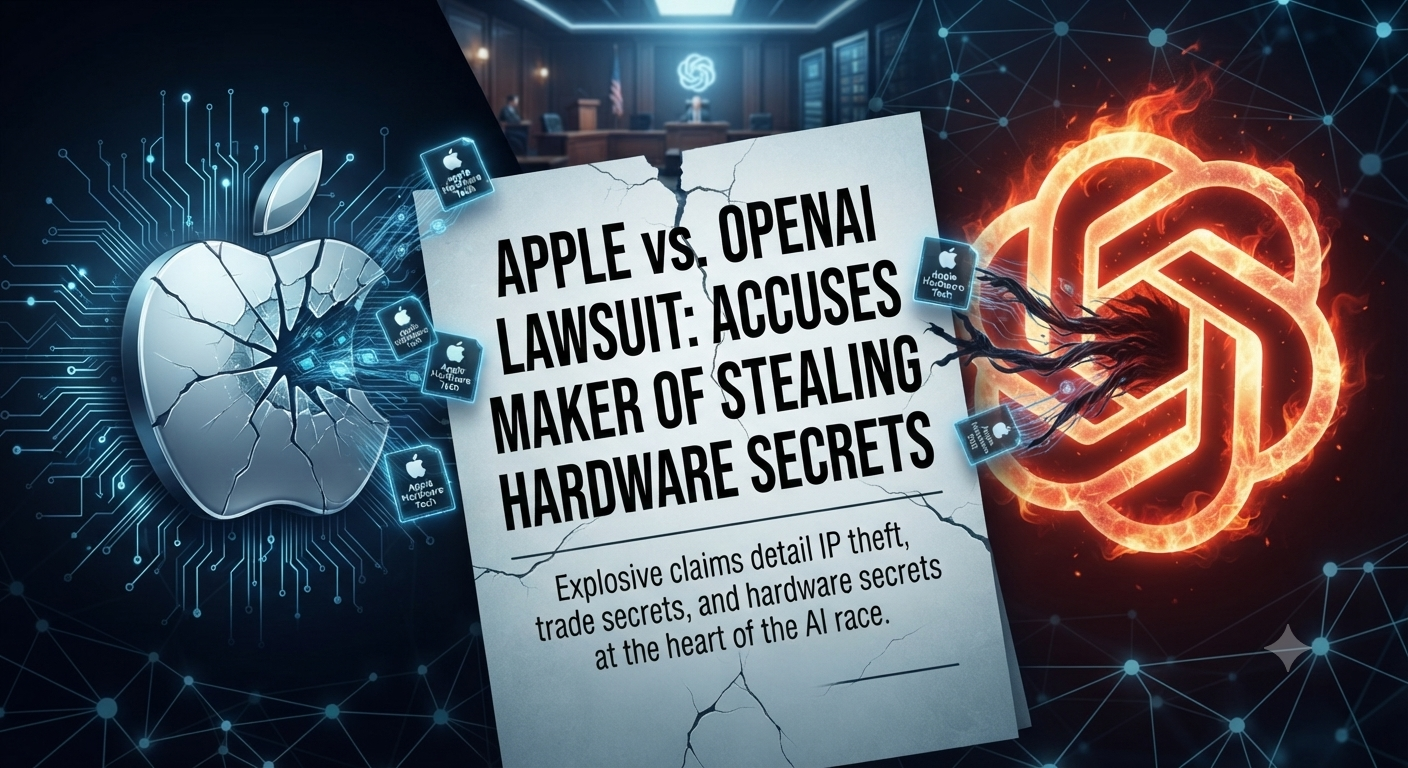
Two years ago, they were partners. Now they are opponents in federal court.
The Apple OpenAI lawsuit, filed Friday, July 10, in the US District Court for the Northern District of California, accuses the ChatGPT maker and two of Apple’s own former employees of a coordinated effort to take confidential hardware information and use it to build OpenAI’s first consumer device. The 41-page complaint names OpenAI, its hardware subsidiary io Products, and two individuals, one of whom is now OpenAI’s chief hardware officer.
Here is what Apple alleges, how OpenAI is answering, and why this fight was probably coming either way.
What the Apple OpenAI Lawsuit Alleges
Apple’s complaint describes a pattern rather than a single incident, claiming the alleged misconduct ran, in its words, at every level of OpenAI, from technical staff up to its chief hardware officer, and that more than 400 former Apple employees now work at the AI company.
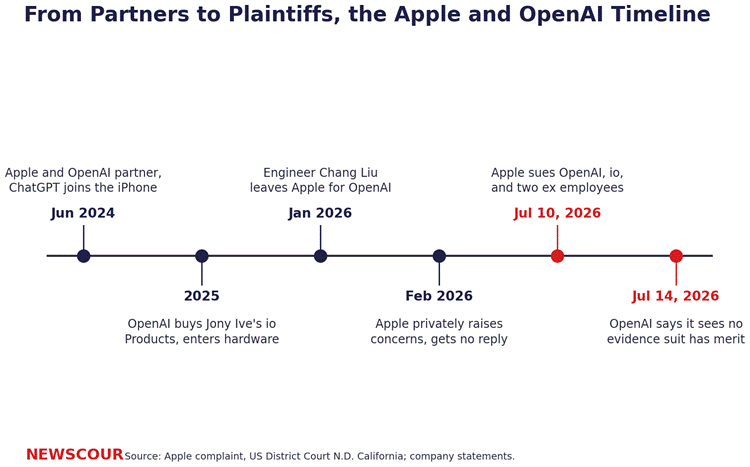
The specifics are unusually detailed for a filing of this kind. Apple alleges that departing employees emailed themselves supplier lists and internal summaries, that job candidates were asked about Apple projects by their internal code names, and that some were encouraged to bring actual hardware components to interviews for show-and-tell sessions. The complaint also claims OpenAI gave new hires guidance on getting around Apple’s security procedures. Apple says it raised its concerns privately with OpenAI in February and never received a response.
Apple is asking the court to bar OpenAI from using or disclosing the material, order the return of confidential files, and award damages, alongside breach-of-contract claims against the two former employees individually. The case was filed with the US District Court for the Northern District of California.
The Two Names at the Center of It
The first is Tang Yew Tan, a roughly 24-year Apple veteran who led product design for the iPhone and Apple Watch before leaving in February 2024 to work with former Apple design chief Jony Ive. He is now OpenAI’s chief hardware officer. Apple alleges Tan emailed himself supplier information before departing and later used interviews to extract details about unreleased Apple products.
The second is Chang Liu, a senior systems electrical engineer who spent eight years at Apple before joining OpenAI in January 2026. The complaint alleges Liu exploited a security flaw to reach shared network storage through a former colleague’s access and downloaded more than a thousand pages of technical files on Apple’s circuit board manufacturing, then joked about the access in a message to a former coworker. These are allegations in a civil complaint, and neither man has been found liable for anything.
How OpenAI Is Responding
OpenAI’s first reaction, hours after the filing, was dismissive. A spokesperson said the company has no interest in other companies’ trade secrets and remains focused on its own technology.
Its fuller answer to the Apple OpenAI lawsuit came the following Tuesday, and it hinted at the defense ahead. The company said it takes the allegations seriously but is, in its words, not aware of any evidence that this complaint has merit, and stressed its belief in fair competition and in people’s freedom to work where they choose. That framing matters because Apple is not arguing that its former employees were forbidden from joining a competitor, which California law would not support anyway. It is arguing that they took proprietary files with them. OpenAI has not yet addressed that distinction in detail, and its formal legal response is expected in the coming weeks.
Why This Fight Was Probably Coming
The Apple OpenAI lawsuit stems from a relationship that soured fast. In 2024, the two companies announced a headline partnership that put ChatGPT inside the iPhone’s operating system. Then OpenAI bought Jony Ive’s hardware startup io Products in a deal valued at more than $6 billion, hired heavily from Apple’s hardware ranks, and set out to build a consumer device of its own, one reportedly designed to be aware of its user’s surroundings. Sam Altman said in November that the first prototypes were finished.
A device that reduces how much people rely on their phones is a direct run at Apple’s core business, which explains the force of Apple’s response. The timing stings for OpenAI, too. The company confidentially filed paperwork for a public offering last month, and a trade secret case now hangs over the hardware division it hopes will justify its valuation. Apple, for its part, has said the suit does not touch the existing ChatGPT integration agreement.
What Happens Next
OpenAI’s formal answer to the complaint comes first, likely including a motion to dismiss. If the case survives that stage, discovery would force both companies to open internal records neither wants made public. Most trade secret fights of this size end in settlement, but Apple rarely sues at all, and it did not file 41 pages to walk away quietly. The Apple OpenAI lawsuit may end up shaping not just one gadget but how freely talent and ideas can move in the AI industry.
Follow NEWSCOUR for every turn in the biggest tech fight of the year!