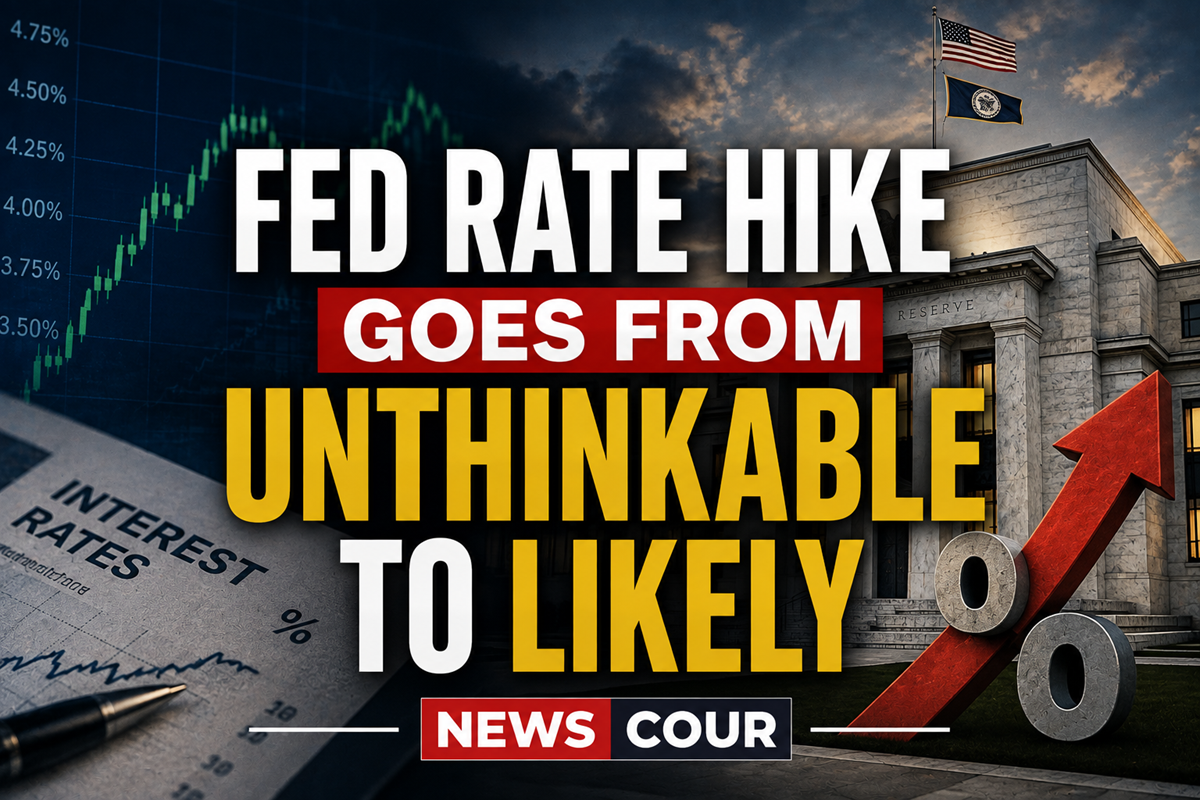
For most of 2026, the debate was how many times the Federal Reserve would cut. Now the question has flipped, and a Fed rate hike is suddenly the live scenario nobody priced in at the start of the year.
The reversal is being driven by one thing above all: war-fueled oil. With the US-Iran conflict keeping crude elevated and inflation stubbornly above target, a Fed rate hike in September has gone from unthinkable to a genuine possibility, and the split inside the central bank is now out in the open.
Here is what changed, why oil is the hinge, and what a higher rate would mean for anyone with a mortgage, a loan, or a savings account.
The Vote That Lowered the Bar
The clearest signal came from the July meeting. The Federal Open Market Committee held its target range at 3.50 to 3.75 percent, but the vote was 9 to 3.
Three members, Beth Hammack, Neel Kashkari, and Lorie Logan, wanted an immediate quarter-point increase. That dissent matters, because it means a move does not require convincing the whole committee. Only a few more votes would turn three dissenters into a majority.
The July minutes reinforced the point. Several officials favored an immediate hike, and many said tightening would likely be necessary if inflation failed to cool.
Why Oil Is the Hinge for a Fed Rate Hike
The through-line from the Strait of Hormuz to your monthly payments runs through energy prices.
The war with Iran has kept crude well above pre-war levels, briefly touching 100 dollars a barrel before easing to around 80. Higher energy costs feed straight into inflation, and inflation is the one thing Chair Kevin Warsh has refused to tolerate drifting from the 2 percent target.
Warsh has declined to offer forward guidance, which leaves the inflation data itself as the deciding force. If energy stays high, the case for a hike strengthens on its own.
What the Odds Actually Say
Market pricing has swung wildly, and that is the honest caveat. Fed funds futures have moved from below 53 percent to above 80 percent and back toward a coin flip within weeks, depending on each new oil print and jobs report.
The consensus among economists still leans toward a hold. But several major banks have shifted their base case, with J.P. Morgan now penciling in a quarter-point increase in September, a reversal from its earlier no-change call.
The takeaway is not that a hike is certain. It is that the burden of proof has flipped from those expecting a hike to those expecting a hold.
What a Higher Rate Would Mean for You
A Fed rate hike would ripple outward quickly.
Borrowing gets more expensive first. Mortgages, car loans, and credit-card rates all track the Fed’s benchmark, so a hike raises the cost of new debt and variable balances.
Savers benefit on the other side, as high-yield accounts and new bonds pay more. And for the wider economy, tighter policy is designed to cool demand, which can slow growth even as it fights prices.
The Federal Reserve publishes its rate decisions and economic projections directly, and the September meeting is the one to watch. The pressure traces back to the US strikes on Iran and the oil shock they set off. Whether the dissenters become a majority depends on data the Fed does not control, and on a war being fought a world away from the boardroom where the vote will happen.